Hostify Server Hosting Dashboard: Streamline Your Web Management
Imagine logging into your server management panel after a long weekend, expecting the usual clutter of graphs and cryptic error logs, but instead, you are greeted by a clean, intuitive interface that feels more like a high-end productivity app than a backend tool. For anyone running a cloud hosting business, managing a VPS, or offering web services, the difference between a chaotic backend and a streamlined one isn't just aesthetic—it's a matter of operational efficiency. The Hostify Server Hosting Dashboard template addresses this exact pain point, offering a modern, pixel-perfect solution for professionals who need to manage complex data without sacrificing user experience.
Why Modern Hosting Businesses Need Better Visual Tools
In the world of web hosting and SaaS, trust is built in milliseconds. Whether you are a freelance developer handing off a project to a client, or a startup launching a new cloud platform, the backend interface you present speaks volumes about your professionalism. A dated, confusing dashboard can make even the best server infrastructure feel unreliable. This is where the Hostify Server Hosting Dashboard steps in. It isn't just a collection of charts; it is a carefully crafted layout designed to make data consumption effortless. By leveraging a modern typography approach and a logical grid system, it ensures that critical information—like server uptime, bandwidth usage, and billing status—is immediately accessible.
The design philosophy here focuses on clarity. In a typical server monitoring scenario, you might be juggling multiple metrics at once. A cluttered screen forces your eyes to dart around, increasing cognitive load. Hostify solves this through strategic whitespace and a hierarchy that guides the user naturally from high-level overviews to granular details. This is particularly vital for web design professionals who manage multiple client sites; you need to see the health of your entire fleet at a glance, not just one node.
Designing for Functionality: The Anatomy of a Great Admin Interface
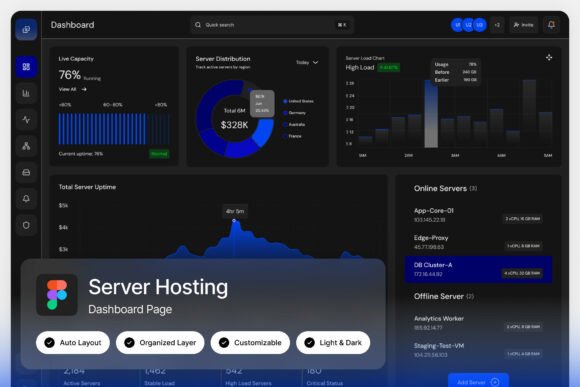
When we talk about brand identity in the context of software, the UI/UX is the brand. The Hostify Server Hosting Dashboard embraces a clean aesthetic that balances form and function. It features two high-quality screen resolutions (1440×1024 px), ensuring that the design looks sharp on standard monitors and high-resolution displays alike. But what really sets this template apart is its flexibility regarding visual themes.
The inclusion of both Light and Dark mode interfaces is a significant practical advantage. Server administrators often work in low-light environments or during late hours. A harsh, bright white screen can cause eye strain, while a poorly designed dark mode can make text unreadable. Hostify provides a balanced contrast in both modes, ensuring that the readability of the interface remains high regardless of the ambient lighting. This attention to detail reflects a deep understanding of the end-user's environment.
Furthermore, the layout is built with pixel-perfect precision. For a designer or developer, this means you aren't just getting a rough sketch; you are getting a production-ready asset. The layers are well-organized and named, which is a lifesaver when you need to customize the template for a specific client or product. Instead of spending hours untangling a messy file structure, you can immediately start tweaking colors, swapping out icons, or adjusting the font pairing to match your specific brand guidelines.
Beyond the Dashboard: Adapting the Aesthetic for Marketing Assets
While the primary function of this template is server management, the visual language it establishes can and should extend beyond the admin panel. Consistency is key in brand identity. If your dashboard looks sleek, modern, and professional, but your marketing materials look generic, you create a disconnect in the customer's mind.
Consider using the design elements from the Hostify Server Hosting Dashboard to inspire your broader design assets. The color palette and layout logic are perfect for:
- Social Media Graphics: Create announcements for new features or maintenance windows that look like they belong to the same family as your software. The clean aesthetic translates perfectly to platforms like LinkedIn and Twitter.
- Pitch Decks and Presentations: When pitching your hosting services to investors or enterprise clients, a slide deck that mirrors the professionalism of your dashboard interface reinforces your credibility.
- Web Design Elements: If you are building a landing page for your hosting service, the UI kit provided in the dashboard can serve as a foundation for the "Features" or "Pricing" sections of your site.
- Documentation and PDF Guides: Use the typography and layout grids to create user manuals or "Help Guides" that feel integrated with the software itself.
By treating the dashboard as the cornerstone of your visual identity, you ensure that every touchpoint a customer has with your brand—from logging in to paying their bill—feels cohesive and intentional.
Practical Tips for Customization and Implementation
Getting the most out of a premium font and layout template requires a bit of strategy. The Hostify Server Hosting Dashboard comes with free Google Fonts included, which is a practical choice for web-based applications due to their ease of implementation and readability across browsers. However, you might want to inject more personality into your specific brand.
If you decide to swap the typography, look for a sans serif font that maintains high legibility at small sizes, as dashboard text is often dense. A modern typeface with a large x-height will ensure that labels and data points remain crisp. Avoid overly decorative script fonts or complex serif fonts for the main data interface; save those for headers or marketing spin-offs where you have more space to breathe.
When editing the Figma file, pay attention to the "well-organized" layers. Use the grouping to your advantage. For example, if you are rebranding for a client in the fintech sector, you might want to adjust the color coding of the graphs to match their specific compliance colors. Because the layers are named intuitively, you can quickly find the "Active Users" chart or the "Server Load" widget and apply global color changes without breaking the layout structure.
Finally, don't overlook the importance of the Dark Mode. It is not just a "cool" feature; it is a functional requirement for many power users. When customizing, ensure that your contrast ratios remain accessible. A common mistake in web design is choosing a dark grey background with black text, which disappears. The Hostify template has already solved this, but if you change the palette, double-check that your foreground elements pop against the background in both modes.
Optimizing the User Experience for Your Clients
If you are a creative entrepreneur or an agency building a dashboard for a client, the goal is to reduce the learning curve. A unique and stylish design shouldn't come at the expense of usability. The Hostify layout strikes this balance by using familiar patterns—sidebars for navigation, top bars for search and profile settings, and card-based layouts for data modules.
Think about the specific needs of your audience. Are they technical sysadmins who need raw data access, or are they small business owners who just want to know if their site is up? The template allows for customization that caters to both. You can emphasize the "Server Monitoring" graphs for the technical crowd, or you can highlight the "Billing" and "Support" sections for the less technical user.
Moreover, the resolution of 1440×1024 px is a smart choice for a master design file. It represents a standard "desktop" view that scales reasonably well to smaller laptops. When you are presenting the design to a stakeholder, seeing it at this size gives a realistic impression of how it will function in a real-world office environment. It moves the conversation away from abstract wireframes and toward a tangible product.
In the end, the Hostify Server Hosting Dashboard is more than just a UI kit; it is a tool for building trust. By presenting your technology through a lens of clarity, organization, and modern design, you tell your users that you value their time and experience. Whether you are launching a new cloud startup or refining an existing platform, investing in a high-quality, customizable interface is one of the smartest moves you can make for your brand's long-term success.